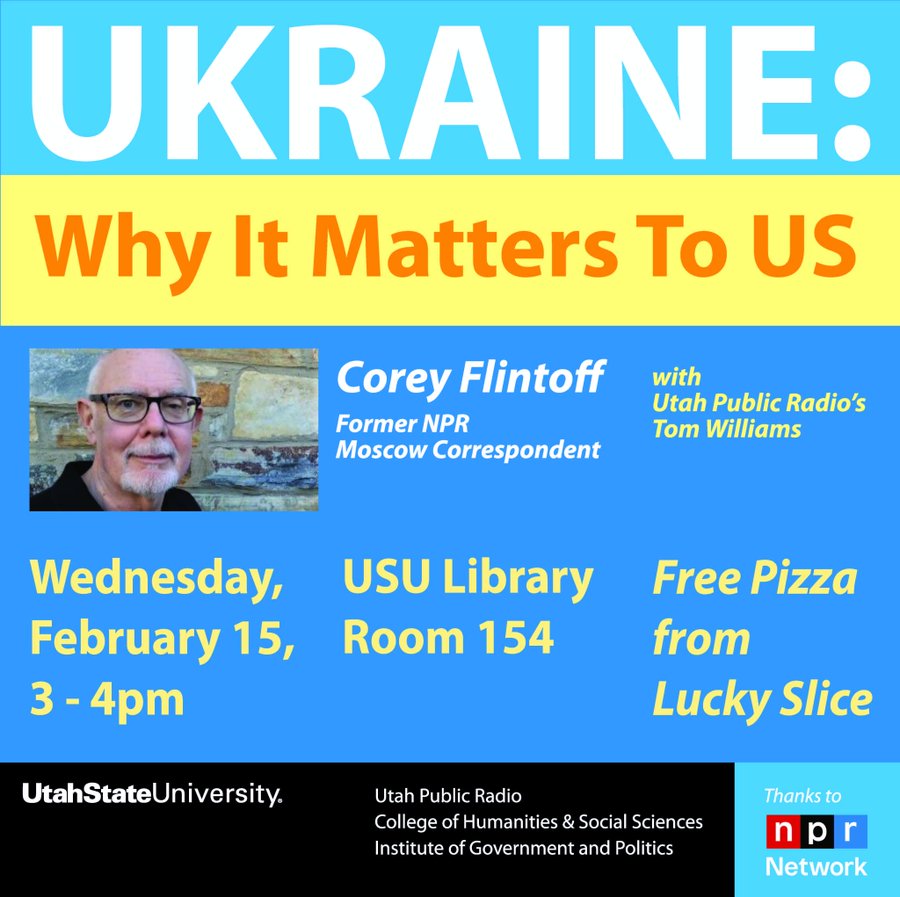
Thursday, February 16, 6:00 PM. I’m really looking forward to this, because it helps bring attention to the Corey Flintoff Student Internship Fund, a program that’s dear to my heart. The fund supports the next generation of reporters and journalists by providing real-world experience and skill-building.
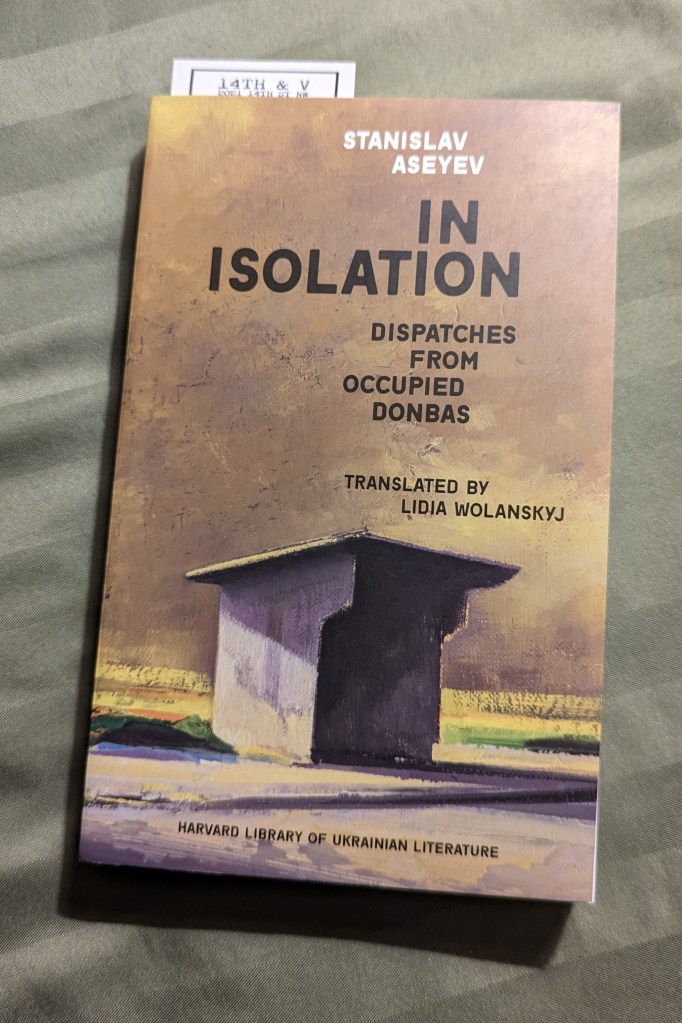
My daughter Claire is currently in Poland, attending the Warsaw Film School, so she did her Christmas shopping online this year and sent us books that she knew we’d like. To Diana, who is a close student of anything about Ukraine, she sent In Isolation: Dispatches from Occupied Donbas by Stanislav Aseyev, a book I can’t wait to read. Aseyev is a Ukrainian journalist who was jailed for more than thirty-one months in occupied Donetsk. The charges brought against him by Russia’s puppet regime in Donetsk were deliberately absurd, for instance, putting quotation marks around the name “Donetsk People’s Republic.” The DPR is the Soviet-sounding name chosen by the regime, and its prosecutors claimed that by putting the name in quotes, Aseyev was casting doubt on the legitimacy of the region that Russia now claims as its own.
The book is recommended by two journalists I very much admire, Simon Ostrovsky and Peter Pomerantsev, which would be reason enough to read it, but I have a personal reason. From 2014 to 2016, I covered the Russian subversion and aggression in Ukraine for NPR, and saw firsthand how Putin’s agents simulated “separatist” movements in the Donbas to justify their takeover. (They did it in Crimea first, of course, and Aseyev opens his book with a handy timeline that helps put the history in place.)
I was NPR’s correspondent in Moscow at the time, and I traveled to Donetsk and Luhansk when the first “pro-Russian” or “separatist” protests were staged. It was a pretty rich reporting environment, because everything was in flux and we could travel anywhere and talk to anyone without restrictions. The “protestors” managed to take over and occupy government buildings in the two main provincial cities, blocking them with barricades and small but noisy demonstrations. The people manning the barricades looked like thugs, many of them skinhead types with visible prison tattoos. The demonstrators were mostly older people, especially some grannies who seemed to remember Stalin and the Soviet era fondly.
Pro-Russian groups staged protests in downtown Donetsk, small at first but gaining in momentum and funding. (photo by the author).
It’s true that there were lots of pro-Russian people in Donetsk. It’s a mainly Russian-speaking region on the border where people regularly traveled back and forth. People, especially older ones, had their grievances, too. Pensions were meager, never enough to get by on in a quickly modernizing city. Retired people in Donetsk knew that Russian pensions were slightly better. Although Donetsk was getting posh stores and cafés, national funds for infrastructure were systematically syphoned off by corrupt politicians. Outside the city center, the streets were potholed and public facilities were shabby.
As so often happens though, angry people misplaced the blame. The ousted president of Ukraine, Victor Yanukovych, began his spectacularly corrupt career in Donetsk, where he partnered with Soviet-era gangsters and eventually worked his way up to provincial governor. He amassed impressive wealth without ever holding anything but low-paying public sector jobs. Pro-Russian people I interviewed acknowledged that Yanukovych was a crook, “but he’s our crook,” imagining that the governor had somehow been directing some of his ill-gotten gains to his home province, when he’d actually been ripping them off for years. When Yanukovych was elected president, he began immediately to dismantle Ukraine’s democracy and to enrich himself and his cronies even further.
The grievances that pro-Russian people in the Donbas complained of were not brought on by Ukrainian nationalists, but by one of their own, Putin’s favorite, Viktor Yanukovych. (Actually, Putin is said to despise Yanukovych for being weak and cowardly, but Kremlin leader has always found greed and corruption to be useful qualities in his allies.) The “separatist” leaders who Russia put in power in Donbas were just the same, opportunistic grifters who saw a chance to cash in and gain legitimacy under Putin’s sponsorship.
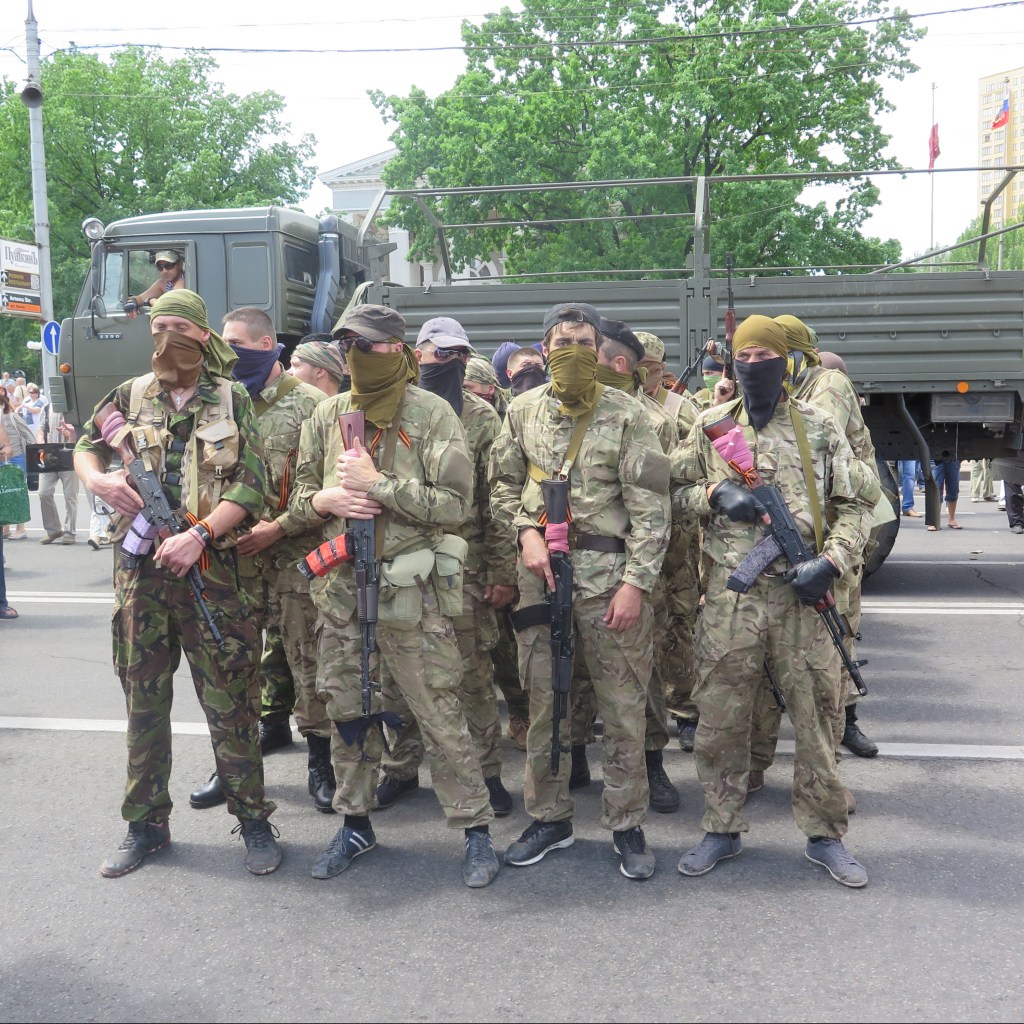
“DNR” leaders assembled a ragtag militia in Donetsk. The day after this picture was taken, these gunmen tried to seize the airport, but most were killed by the Ukrainian Army. (Photo by the author)..
A good example was Aleksandr Zakharchenko, a former electrician who helped form the pro-Russian militia that went on seize the Donetsk government buildings. He was bold, clever and unscrupulous enough to get the Donetsk puppet government to name him first “major general” and eventually “prime minister” of the breakaway province. He signed the Second Minsk Agreement but immediately declared that he would not abide by the ceasefire in parts of the region. He was racking up a record as a human-rights abuser and war criminal when he was killed by an explosion in a Donetsk café in August of 2018.
Since my retirement, I’ve only been able to follow the situation in Donbas though news stories and conversations with friends from the region. I welcome In Isolation as a first-hand account of the occupation that Russia has now escalated into full-scale war. Stanislav Aseyev’s book is translated by Lidia Wolanskyj and published by the Harvard Library of Ukrainian Literature.


 Corey Flintoff