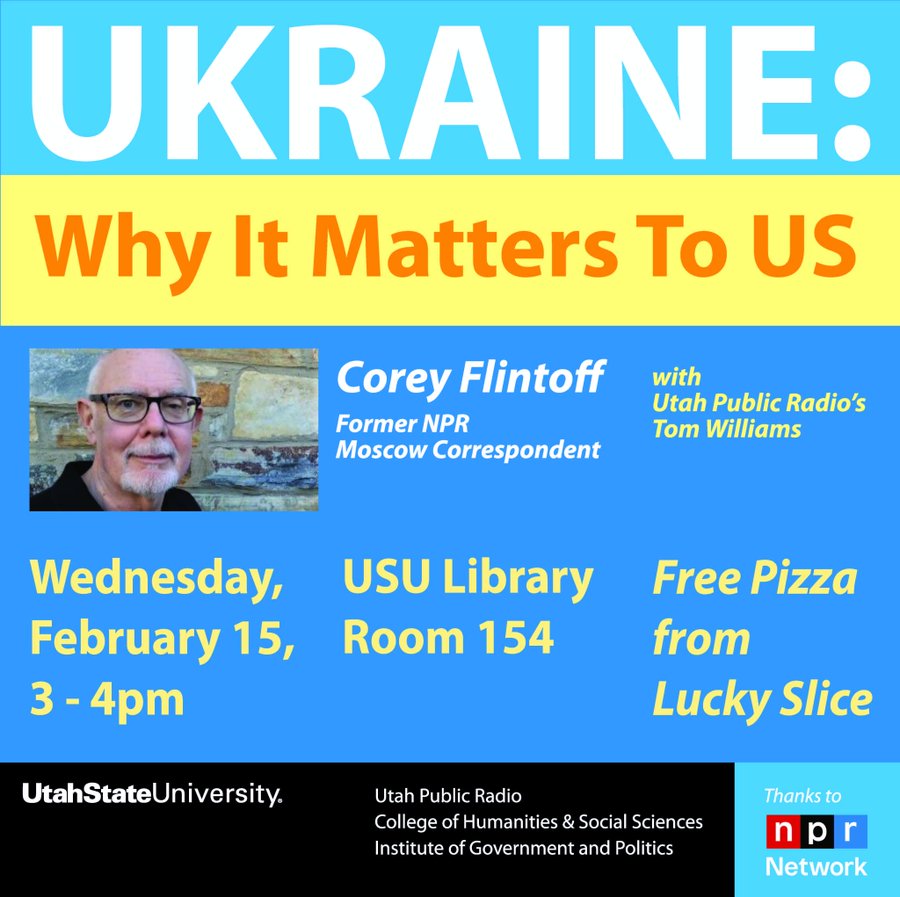
Thursday, February 16, 6:00 PM. I’m really looking forward to this, because it helps bring attention to the Corey Flintoff Student Internship Fund, a program that’s dear to my heart. The fund supports the next generation of reporters and journalists by providing real-world experience and skill-building.
I didn’t intend this site to be political or historical, but the challenges of our time demand that we do both. As we follow the war maps and reports from eastern Ukraine, it’s almost unbelievable how quickly the Ukrainian army has seized the initiative and recovered territory that was lost in Russia’s grinding summer offensive. Some commentators are already claiming that they told us so, that they somehow foresaw the Ukrainian strategy, and that may be so, but I confess: I didn’t see this coming. I was, of course, cautiously excited by the Ukrainian offensive around Kherson. I say cautiously, because it seemed almost too good to be true that Ukraine was corralling a Russian force of more than twenty thousand troops and cutting them off from their supply lines to Crimea. I did fantasize that now might be a good time for the Ukrainians to try a feint in the Kharkiv area, a surprise attack that might throw the Russians off their guard and distract them from the main battle in Kherson, but that was only a fantasy. Little did I know that the Ukrainian Army had the wherewithal to mount a real offensive in the northeast, or that the Russians were so ill-prepared there that their defense would collapse. I think it’s still important to be cautious. It seems almost impossible that the Russian commanders could really be as incompetent as they’ve shown themselves to be, so some small part of me fears this could be a trap. So far, though, that’s a very small part. The rest of me is cheering on the Ukrainians as they reclaim their stolen land.
Oh, and here’s one more piece of personal satisfaction: it’s reported that Denis Pushilin, the craven opportunist and traitor who acted as Russia’s puppet in Donetsk, has fled the city. Pushilin was a small-time grifter who became a Russian mouthpiece after the Russians fomented a fake “insurgency” in the province. As a correspondent in the years immediately following the Russian takeover in Donetsk, I had to cover so-called press conferences in which Pushilin and his cronies claimed to leaders of a separatist insurgency. If the reports are true, I’ll be glad that Pushilin followed the example of his predecessor, Viktor Yanukovich, and high-tailed it out of town when the going got tough.
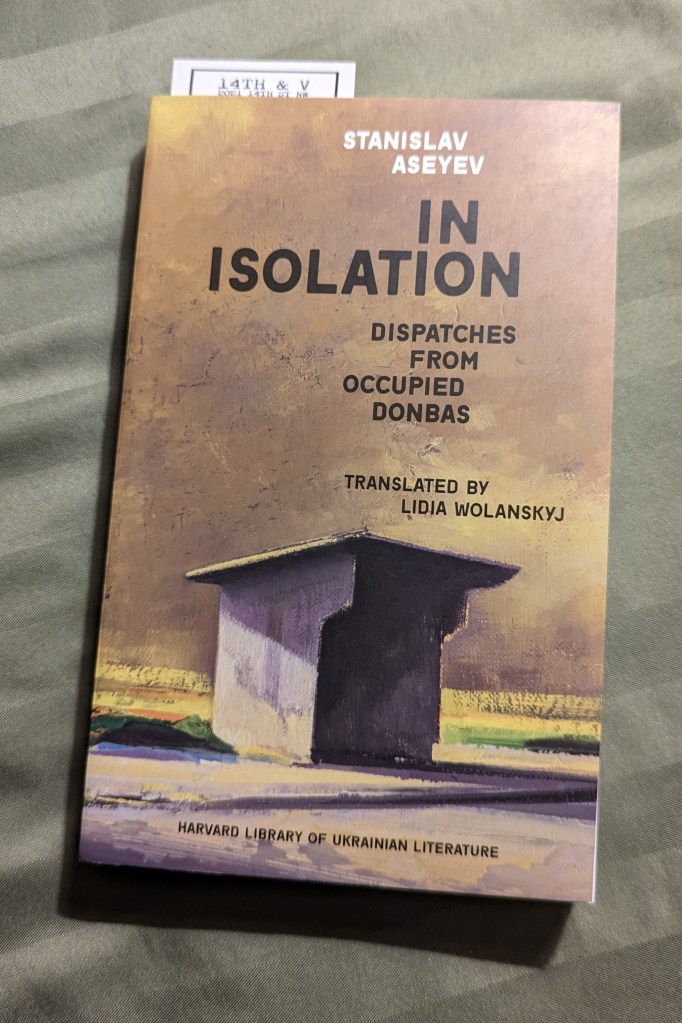
My daughter Claire is currently in Poland, attending the Warsaw Film School, so she did her Christmas shopping online this year and sent us books that she knew we’d like. To Diana, who is a close student of anything about Ukraine, she sent In Isolation: Dispatches from Occupied Donbas by Stanislav Aseyev, a book I can’t wait to read. Aseyev is a Ukrainian journalist who was jailed for more than thirty-one months in occupied Donetsk. The charges brought against him by Russia’s puppet regime in Donetsk were deliberately absurd, for instance, putting quotation marks around the name “Donetsk People’s Republic.” The DPR is the Soviet-sounding name chosen by the regime, and its prosecutors claimed that by putting the name in quotes, Aseyev was casting doubt on the legitimacy of the region that Russia now claims as its own.
The book is recommended by two journalists I very much admire, Simon Ostrovsky and Peter Pomerantsev, which would be reason enough to read it, but I have a personal reason. From 2014 to 2016, I covered the Russian subversion and aggression in Ukraine for NPR, and saw firsthand how Putin’s agents simulated “separatist” movements in the Donbas to justify their takeover. (They did it in Crimea first, of course, and Aseyev opens his book with a handy timeline that helps put the history in place.)
I was NPR’s correspondent in Moscow at the time, and I traveled to Donetsk and Luhansk when the first “pro-Russian” or “separatist” protests were staged. It was a pretty rich reporting environment, because everything was in flux and we could travel anywhere and talk to anyone without restrictions. The “protestors” managed to take over and occupy government buildings in the two main provincial cities, blocking them with barricades and small but noisy demonstrations. The people manning the barricades looked like thugs, many of them skinhead types with visible prison tattoos. The demonstrators were mostly older people, especially some grannies who seemed to remember Stalin and the Soviet era fondly.
Pro-Russian groups staged protests in downtown Donetsk, small at first but gaining in momentum and funding. (photo by the author).
It’s true that there were lots of pro-Russian people in Donetsk. It’s a mainly Russian-speaking region on the border where people regularly traveled back and forth. People, especially older ones, had their grievances, too. Pensions were meager, never enough to get by on in a quickly modernizing city. Retired people in Donetsk knew that Russian pensions were slightly better. Although Donetsk was getting posh stores and cafés, national funds for infrastructure were systematically syphoned off by corrupt politicians. Outside the city center, the streets were potholed and public facilities were shabby.
As so often happens though, angry people misplaced the blame. The ousted president of Ukraine, Victor Yanukovych, began his spectacularly corrupt career in Donetsk, where he partnered with Soviet-era gangsters and eventually worked his way up to provincial governor. He amassed impressive wealth without ever holding anything but low-paying public sector jobs. Pro-Russian people I interviewed acknowledged that Yanukovych was a crook, “but he’s our crook,” imagining that the governor had somehow been directing some of his ill-gotten gains to his home province, when he’d actually been ripping them off for years. When Yanukovych was elected president, he began immediately to dismantle Ukraine’s democracy and to enrich himself and his cronies even further.
The grievances that pro-Russian people in the Donbas complained of were not brought on by Ukrainian nationalists, but by one of their own, Putin’s favorite, Viktor Yanukovych. (Actually, Putin is said to despise Yanukovych for being weak and cowardly, but Kremlin leader has always found greed and corruption to be useful qualities in his allies.) The “separatist” leaders who Russia put in power in Donbas were just the same, opportunistic grifters who saw a chance to cash in and gain legitimacy under Putin’s sponsorship.
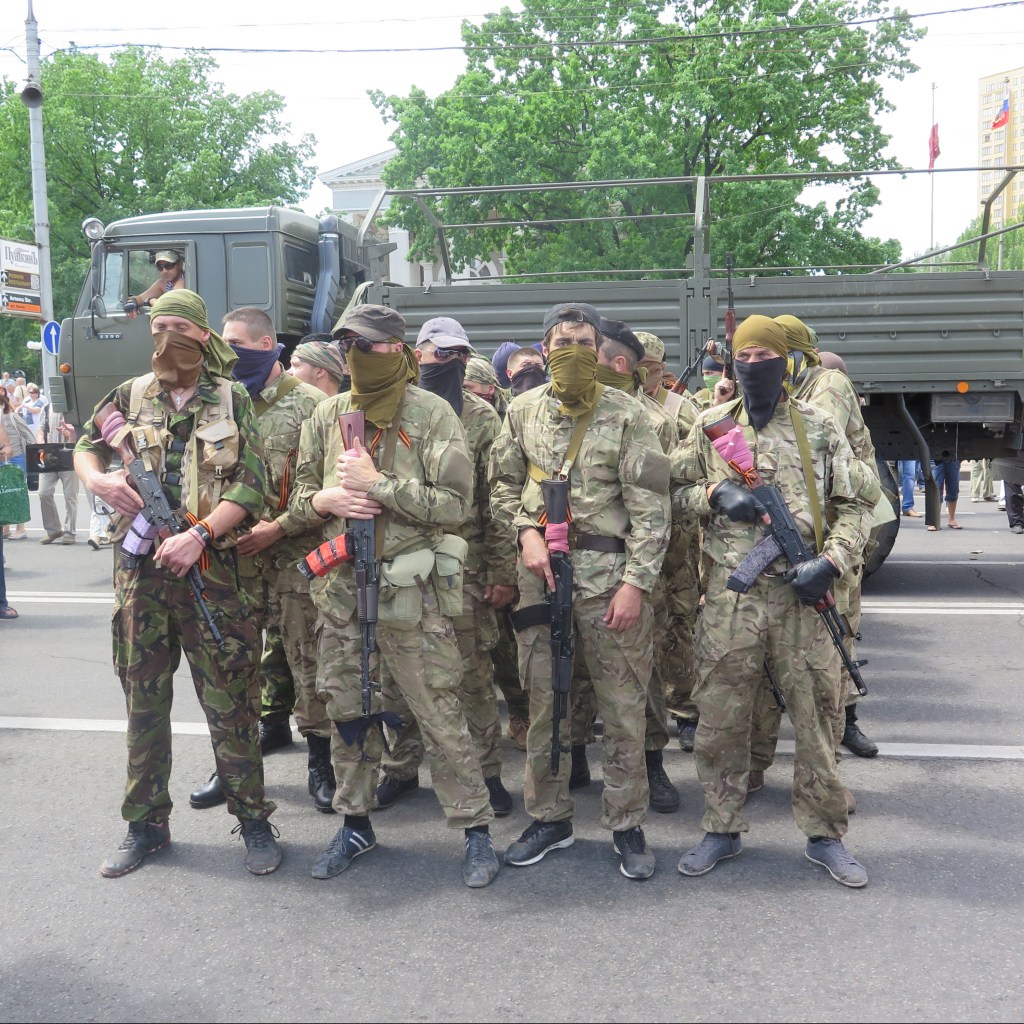
“DNR” leaders assembled a ragtag militia in Donetsk. The day after this picture was taken, these gunmen tried to seize the airport, but most were killed by the Ukrainian Army. (Photo by the author)..
A good example was Aleksandr Zakharchenko, a former electrician who helped form the pro-Russian militia that went on seize the Donetsk government buildings. He was bold, clever and unscrupulous enough to get the Donetsk puppet government to name him first “major general” and eventually “prime minister” of the breakaway province. He signed the Second Minsk Agreement but immediately declared that he would not abide by the ceasefire in parts of the region. He was racking up a record as a human-rights abuser and war criminal when he was killed by an explosion in a Donetsk café in August of 2018.
Since my retirement, I’ve only been able to follow the situation in Donbas though news stories and conversations with friends from the region. I welcome In Isolation as a first-hand account of the occupation that Russia has now escalated into full-scale war. Stanislav Aseyev’s book is translated by Lidia Wolanskyj and published by the Harvard Library of Ukrainian Literature.
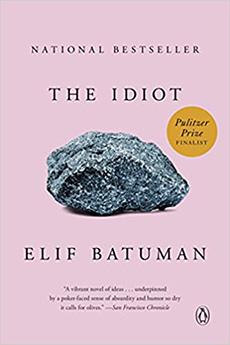
I was feeling that I’ve been listening to a lot of popular froth, so I chose this novel about a Turkish-American freshman at Harvard. It’s very insightful about very bright, insecure young people in a rarified environment. Selim falls in love with a Hungarian Senior, a manipulative guy who seems to enjoy exercising power over her (and seems to be hoping that he can get her to throw herself at him, presumably so he can have sex with her without feeling any responsibility himself). Her charm is that she’s naïve but has a lot of personal integrity. I got a bit impatient with the minutely dissected love story, but still, the novel is compelling.
Finished July 6, 2022.
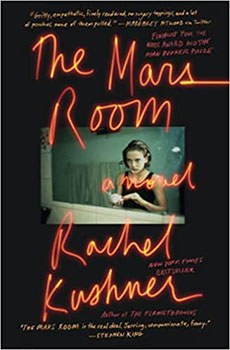
THE MARS ROOM
Rachel Kushner
I loved this novel about a lap dancer/stripper at a seedy men’s “club” in San Francisco. She kills her stalker, gets 35 years in prison, loses the only thing she really cares about, her little boy. The novel combines her memories of growing up feral in S.F., life in prison, stories of the friends she makes there. I spent my teenage years in San Francisco and Kushner nails it. She read the audiobook herself. It was absolutely brilliant.
Finished July 6, 2022
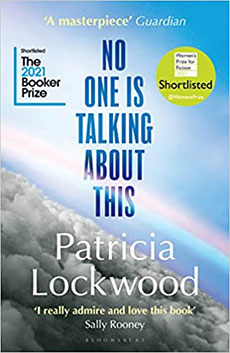
No One Is Talking About This
Patricia Lockwood
I saw this on a recommended list, but confused the writer with Patricia Highsmith. Turns out it’s a wonderful memoir-like novel about a woman who is a successful blogger and social-media wit, but is addicted to an essentially empty life online. Her sister has a baby with the same syndrome that created the Elephant Man, whom they all love and who, in her short life, gives meaning to their lives. Beautiful and heart-rending. Lockwood is a poet, and her language is gorgeous.
Finished May 26, 2022
The Yiddish Policemen’s Union
Michael Chabon
I’d read this before and enjoyed it, but saw it again on a list of books with a claim to being a “great American novel.” It is—and how. A beautiful piece of writing, certainly one of the best noir novels ever written, probably one of the best Jewish books, too. I loved it, and I loved hearing it read.
Finished May 22, 2022
Orange World and Other Stories
Karen Russell
I really liked most of the stories, and found that I’d read many of them elsewhere, including my favorite Bog Girl and Black Corfu, stories that start with a bizarre premise and make it produce utterly convincing results. What an imagination this woman has. I’ll definitely come back to this book for inspiration.
Finished April 15, 2022
Harlem Shuffle
Colson Whitehead
I loved this book. It’s an exploration of what it takes for a Black man to exist in a racist society, but it’s also a crime story, set in 1960’s Harlem and beautifully developed. The lead character is a guy whose father was a crook. He’s achieved some respectability at the proprietor of a furniture store, but he’s a fence on the side. Great moral ambiguity. The reader was superb.
Finished March 1, 2022
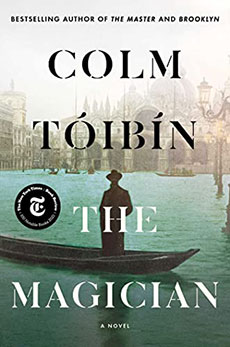
The Magician
Colm Toibin
This novel about Thomas Mann felt like a biography much of the time, although it dramatized moments of family conflict and revealed the queer fantasies of Mann, who apparently never or seldom acted on his natural impulses. I think the problem may be that Mann was an intensely reserved and private man (forced to be, by his sexual orientation, but also by culture, coming from north Germany.) It was hard to get at his real feelings. Anyway, it was engaging throughout, and I enjoyed it.
Finished February 15, 2022
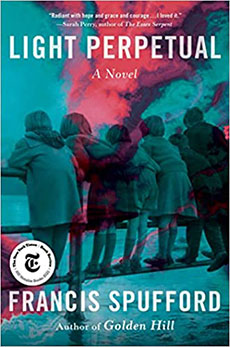
Light Perpetual
Francis Spufford
I really loved this novel about the imagined lives of five children who were killed in a V-2 rocket attack during the London Blitz. What if those children had lived? What would their lives be like? Spufford follows all five lives in roughly 15-year intervals, from elementary school to their early 70s. The stories are completely engrossing and very moving. It was read by the English actress Imogen Church, who is brilliant. I mentioned her in a tweet promoting this book and she responded with a thank you.
Finished January 6, 2022
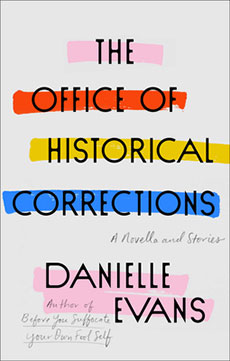
The Office of Historical Corrections
Danielle Evans
I’ve been reading good things about this story collection for quite a while, but when I got it, I realized that I’ve read a couple of the stories in Best American Short Stories and that I follow her on Twitter. She’s terrific, an old-fashioned writer who creates vivid characters and situations and lets them drive the plot. Among my favorites was Boys Go to Jupiter, a story of cascading racism that begins with a confederate-flag bikini.



 Corey Flintoff